
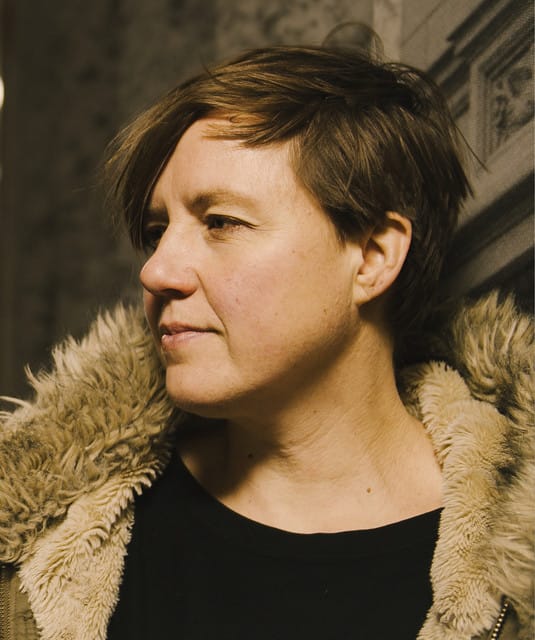
Who Is Masha Qrella? The Complete Biography of Berlin’s Indispensable Indie-Pop Pioneer
For over three decades, Masha Qrella has stood as one of the most vital, transformative, and quietly influential figures in the European independent music landscape. Born Mariana Kurella in East Berlin in 1975, she has spent her career blurring the boundaries between indie rock, minimalist electronica, post-rock, and avant-garde theater.
While her delivery is defined by what critics call a “nonchalant understatement”—often performing with a thoughtfully tilted head and a hushed, conversational vocal style—her artistic impact is massive. From the radical creative freedom of post-wall 1990s Berlin to her recent critical triumphs like Woanders (2021) and Songbook (2025), Qrella has established an indelible legacy as a premier sonic architect.
The Crucible of East Berlin and the Post-Wall Underground
To understand the artistic DNA of Masha Qrella, one must look at the specific historical and cultural geography of her youth. Growing up in East Berlin during the final decade of the German Democratic Republic (GDR), her household was deeply rooted in intellectual curiosity. Her father was a Russian physicist and her mother was a German somnologist (a sleep scientist). This blend of precise, analytical logic and a fascination with the subconscious heavily mirrors the structure of Qrella’s future music: tightly programmed electronic rhythms underneath deeply emotional, dreamlike melodies.
When the Berlin Wall fell in 1989, Qrella was a teenager entering a city undergoing a sudden, surreal metamorphosis. The twilight world of 1990s Berlin became her creative laboratory. The sudden abandonment of state buildings, factories, and residential blocks in the East created a zero-rent, lawless sanctuary for counter-culture art. Free from commercial pressures and institutional gatekeeping, Qrella picked up the guitar and bass, immersing herself in a community that valued raw experimentation above all else.
The Instrumental Foundations: Mina and Contriva (1994–2002)
Before stepping forward as a solo singer-songwriter, Qrella built an underground reputation as a phenomenal multi-instrumentalist and collaborator. In the mid-1990s, she co-founded two foundational Berlin instrumental groups that defined the city’s post-rock era.
Mina
Formed around 1994, Mina merged traditional indie-rock instrumentation with the electronic dance loops that were dominating Berlin’s club subculture. Qrella’s razor-sharp guitar lines and compositional textures helped guide the band to their debut album, Kryptonite (1999). The band’s kinetic energy earned them highly coveted European tour slots opening for international heavyweights such as Calexico, Die Sterne, and The Notwist, introducing Qrella to the realities of the international touring circuit.
Contriva
Concurrently, Qrella formed Contriva, a project that leaned further into atmospheric, moody, and experimental indie rock. Signed to the legendary Monika Enterprise label—founded by pioneering electronic artist Gudrun Gut—Contriva became a critical darling of the German underground. Across landmark releases like Tell Me When (2000) and If You Had Stayed (2003), Qrella mastered the art of minimalism, learning to evoke profound longing and cinematic tension through sparse arrangement choices.
Solo Breakthrough: Finding Her Voice and the Morr Music Era
By 2002, the self-imposed restriction of playing exclusively instrumental music began to restrict Qrella’s expanding creative vision. She made the pivotal choice to step up to the microphone, transforming her experimental textures into fully realized, narrative-driven pop songs.
Luck (2002)
Her solo debut album, Luck, released on Monika Enterprise, was an immediate critical breakthrough. The record introduced her trademark vocal style: a quiet, intimate, and comforting whisper that functioned almost like an extra acoustic instrument amidst glitchy electronic beats and warm basslines. It was a flawless exercise in “indietronica” and “folktronica,” proving that quiet music could hold immense sonic power.
Unsolved Remained (2005)
For her second album, Qrella transitioned to the globally renowned avant-pop label Morr Music. Unsolved Remained expanded her international reach, drawing frequent comparisons to iconic alternative artists like Aimee Mann and Elliott Smith. The album seamlessly integrated organic acoustic strumming with clinical, cold digital percussion, formalizing her signature “warm-meets-cold” sonic philosophy.
The Evolution of a Masterpiece: Chronological Solo Discography
Over nearly a quarter of a century as a solo artist, Qrella has refused to replicate the same record twice. Her discography charts a fearless journey away from straightforward indie pop toward sweeping, high-concept multimedia masterpieces.
| Year | Album Title | Record Label | Core Musical & Thematic Focus |
| 2002 | Luck | Monika Enterprise | Debut solo effort; minimalist folktronica, intimate English vocals. |
| 2005 | Unsolved Remained | Morr Music | Expanded international indie-rock arrangements; melancholic storytelling. |
| 2009 | Speak Low: Loewe and Weill in Exile | Morr Music | Deconstructed interpretations of classic Broadway theater standards. |
| 2012 | Analogies | Morr Music | Richly layered dream-pop; inclusion of more prominent synthesizer lines. |
| 2016 | Keys | Morr Music | Sleek synth-pop and electronic indie; highly rhythmic and precise. |
| 2021 | Woanders | Staatsakt | German-language adaptations of poetry by GDR author Thomas Brasch. |
| 2025 | Songbook | Staatsakt | Masterful, minimalist reworkings of timeless rock and pop classics. |
Crossing Media Lines: Theater, Cinema, and High-Art Commissions
One of the defining attributes of Masha Qrella’s career is her refusal to be contained by the traditional music industry album-and-tour cycle. Instead, she has increasingly operated as a high-concept composer for theater, cinema, and radio plays.
Speak Low: Loewe and Weill in Exile (2009)
Commissioned by Berlin’s prestigious Haus der Kulturen der Welt to mark its 50th anniversary, Qrella took on the massive challenge of reinterpreting classic Broadway songs written by exiled legendary German composers Kurt Weill and Frederick Loewe. Rather than leaning into theatrical bombast, Qrella stripped the pieces down to their bare bones. Armed with her signature quiet vocals and minimal instrumentation, she perfectly captured the innate loneliness, displacement, and resilient hope lying at the heart of the original texts.
Woanders (2021) and Critical Super-Stardom
In 2021, Qrella released Woanders (“Elsewhere”), widely considered a crowning achievement in contemporary German art-pop. The project began as a multimedia stage production at Berlin’s famous HAU (Hebbel am Ufer) theater. It featured Qrella setting the dense, evocative poetry and prose of the late East German writer and filmmaker Thomas Brasch to rich electroacoustic arrangements.
The project was an unconditional critical triumph, winning the highly prestigious German Record Critics’ Award (Preis der deutschen Schallplattenkritik) and being named “Radio Play of the Month” by the Akademie der Künste. It bridged her childhood roots in the GDR with her contemporary mastery of independent pop.
Recent Milestones: The VIA Award, Songbook, and International Fellowships
Entering the mid-2025s and 2026, Qrella’s artistic momentum has only accelerated, marked by major career accolades and high-profile international creative residencies.
-
The VIA Critics’ Award (2025): In late 2025, Qrella was officially honored with the highly coveted Critics’ Award for “Best Act” by the VUT (Association of Independent Music Entrepreneurs), cementing her status as a revered icon of the German independent music community following the launch of her album Songbook.
-
The Villa Aurora Fellowship (2026): For 2026, Qrella was awarded the prestigious Villa Aurora Fellowship in Los Angeles, California. Spending extended time in the United States, her work in 2026 centers on exploring the complex emotional distance from her childhood in the GDR, unpacking the prevailing myths of 1990s Berlin, and critically evaluating the role of music as an escapist youth culture.
-
Stripped-Down Solo Performances (2026): Alongside major ensemble works, Qrella continues to tour an intimate live show format. Throughout 2026, she has performed specialized reading-and-concert sets featuring just her voice and an acoustic guitar, debuting rarely played live rarities such as Arthur (a poignant musical adaptation of a story by Einar Schleef).
Core Artistic Collaboration and Live Lineup
While Qrella writes and conceptualizes with singular focus, her recorded works and dynamic live shows rely on deep, long-standing collaborative networks. She fundamentally rejects the trope of the isolated singer-songwriter in favor of collective artistic dialogue.
The Live Trio Dynamics
Her primary live and studio band features a powerhouse lineup of German independent music royalty:
-
Andi Haberl: The widely celebrated, versatile drummer of alternative giants The Notwist, providing the intricate, organic-yet-mechanical rhythmic foundation for Qrella’s songs.
-
Andreas Bonkowski: A highly talented multi-instrumentalist who anchors the arrangements on bass, synthesizers, electronic piano, and backing vocals.
Theater and Interdisciplinary Alliances
Qrella’s work frequently intersects with premier directors, playwrights, and ensembles:
-
Martin Heckmanns: Qrella composed the music for Heckmanns’ acclaimed dystopian Singspiel Etwas Besseres als den Tod finden wir überall, which premiered at the Staatstheater Kassel in 2022 and saw a highly publicized new staging with students from the Ernst Busch Academy of Dramatic Arts in late 2025.
-
Gesine Danckwart: Collaborated on immersive performance formats like the OST-WEST-KANTINE and Chor der unbekannten Heldinnen, driving critical societal conversations around history, feminism, and community through public performance art.
Key Takeaways: The Legacy of Masha Qrella
Masha Qrella represents the absolute best of independent music culture. She has survived the rapid commercialization and shifting trends of the music industry by remaining fiercely dedicated to artistic evolution. By refusing to compromise her signature minimalist aesthetic, she has proven that a whisper can cut through the noise far more effectively than a scream.
Whether she is singing intimate English indietronica, reinterpreting mid-century Broadway showtunes, setting radical East German poetry to techno-infused pop, or spending 2026 interrogating political history in Los Angeles, Qrella remains an indispensable compass for European art and music.
FAQ: Frequently Asked Questions About Masha Qrella
What is Masha Qrella’s real name?
Masha Qrella was born Mariana Kurella. “Masha” is a common Russian diminutive for Mariana, paying homage to her paternal heritage.
What genres of music does Masha Qrella play?
Her diverse body of work spans indie pop, folktronica, post-rock, synth-pop, and electroacoustic experimental music.
Does Masha Qrella sing in English or German?
She sings in both. For the first two decades of her solo career (including her breakthrough albums Luck and Unsolved Remained), she sang almost exclusively in English. With her landmark 2021 album Woanders, she transitioned into singing beautifully in German to accurately capture the nuances of Thomas Brasch’s poetry.
What instruments does she play?
Qrella is an accomplished multi-instrumentalist. In her early bands Mina and Contriva, she primarily played guitar and bass. In her solo career, she plays guitar, bass, keyboards, and arranges electronic programming alongside her lead vocals.
Where is Masha Qrella living now?
She is primarily based in Berlin, Germany, where she lives with her two children and composes for film, theater, and radio, though she spends portions of 2026 in the United States as a cultural fellowship recipient.